Look, I’ll be upfront. Summation of supplies isn’t something I’ve always understood. Someone explained it to me not that long ago and honestly, it didn’t stick straight away. My brain works a certain way — sometimes I need things explained a few times, or in a particular way, before it really lands. That’s just how it is.
What frustrated me more was going looking for decent material on it afterwards and finding basically nothing useful. And yet here I was, expected to go out and start identifying this as a defect on other people’s work. That didn’t sit right with me.
So I did something about it. Spoke to regulators, did the research, built a course around it. The whole point was to get this information out there properly — because keeping knowledge to yourself in this industry helps nobody.
This post is part of that. If you want to go deeper, we’ve built a full CPD course around it — practical, scenario-based, and available through Southwell Solar Training. But more on that below.
So why is this suddenly a thing?
I hear this one a lot. Usually from experienced sparkies who’ve been doing this for decades and are understandably a bit skeptical.
“Current still flows the same way it always has. Why is this an issue now?”
Fair question. And the honest answer is — the installations changed, not the physics.
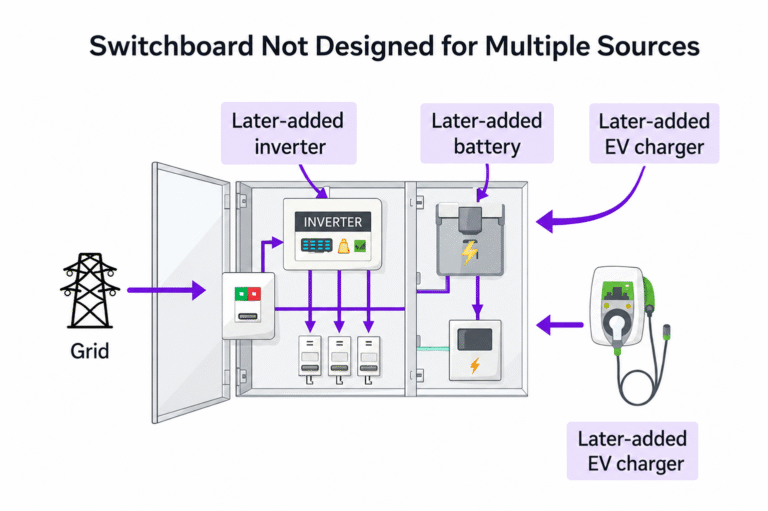
For most of the history of residential electrical work, there was one source of supply. Grid comes in, goes through the main switch, feeds the loads. Simple. The main switch was always the ceiling — it limited what could flow, and everything downstream was sized with that in mind.
That world is gone.
Solar inverters are now large generators. Battery systems are becoming standard. EV chargers are adding continuous background load that simply didn’t exist ten years ago. And most switchboards were never designed with any of this in mind.
Here’s the simple version: there is now a second supply to consider. Sometimes a third. That combined current has to go somewhere — through conductors, busbars, and switchgear that were originally sized for one source.
That’s the problem.
The thing that surprised me most
When I finally got my head around this properly, the biggest aha moment wasn’t what I expected.
I assumed that any time the summation of supplies exceeded the grid supply rating, you had a defect. Turns out that’s not right — and it’s probably the most misunderstood part of this whole topic.
What actually matters is whether the conductors and busbars feeding the loads are rated for the current that can realistically flow through them. If the connected loads are the limiting factor — and they sit within the conductor rating — the installation can be compliant regardless of how much supply is connected.
More supply doesn’t automatically mean a defect. You need to look at what the loads actually add up to, and what the conductors and busbars are rated for. That’s where the real assessment happens.
How to actually assess it
Four steps. Every time.
Step One — add up all the supplies connected to the switchboard. Grid, solar, battery, whatever’s there.
Step Two — check the conductor rating against that summation and against the connected load.
Step Three — check the busbar rating against both the summation of supplies and the maximum demand of the installation.
Step Four — is there a current limiting device in place? What does it limit to? Does it adequately protect what’s downstream of it?
That’s the process. It becomes pretty quick once it’s habit. The complexity comes from the scenarios — older switchboards, retrofitted batteries, changeover switches — but the four steps don’t change.
The busbar problem
Most of the summation defects I find come down to one thing.
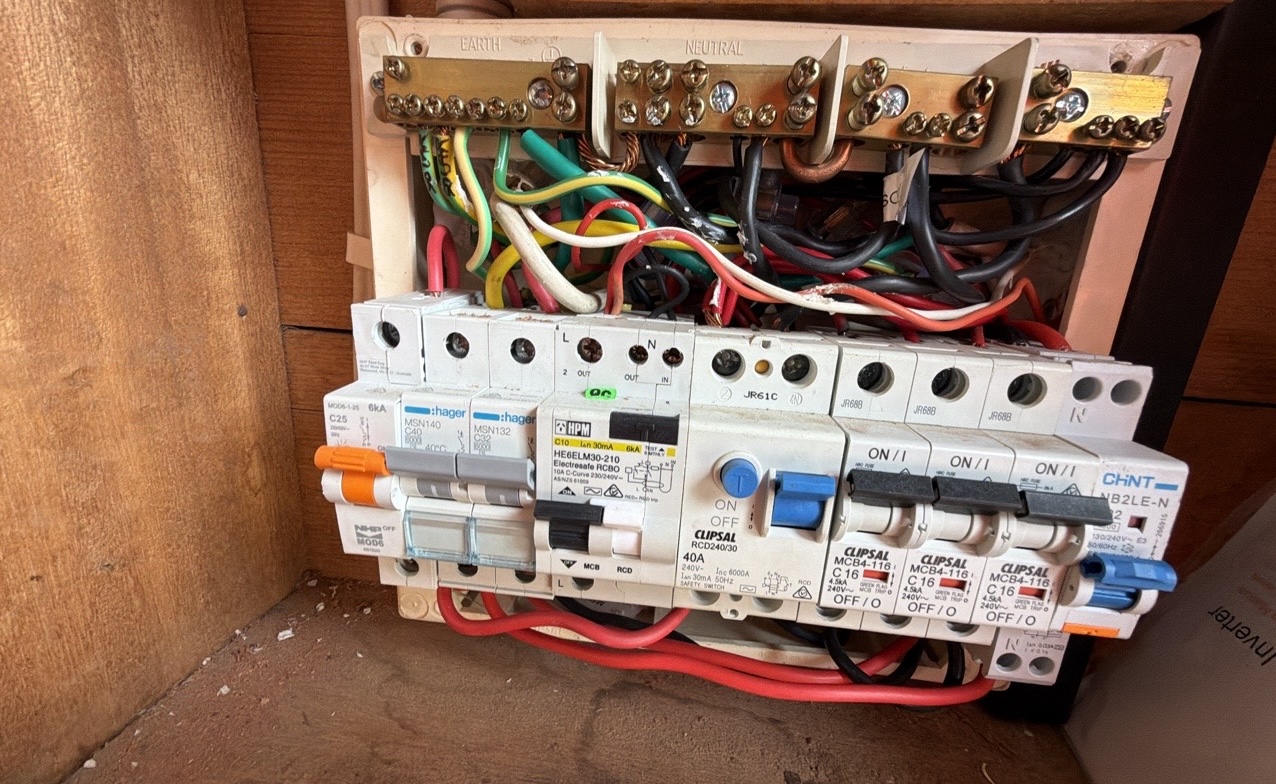
A busbar feeding both inverters and loads together, with nobody having stopped to check what that busbar is actually rated for.
Here’s the thing — busbars are not rated for infinite current. They have a current carrying capacity, same as a cable. In a lot of older switchboards that rating is lower than people assume. Often 80 amps or less.
Add a solar inverter and a battery to an existing installation and that busbar is suddenly carrying combined current from multiple sources simultaneously. If nobody checked the rating, you’ve got a problem sitting there waiting.
The fix in most cases is pretty straightforward. A correctly sized current limiting circuit breaker on the load side of the supply connections protects the busbar, the downstream conductors, and any switchgear in the current path. You don’t always need to replace the busbar or rewire the switchboard. Sometimes the right breaker in the right location is genuinely all it takes.
Why bother writing this
I’m not writing this to lecture anyone. And the course this post sits alongside isn’t designed to catch people out either.
The reality is that installers are getting defect notices on this. Some of them genuinely surprised. And for a long time there just wasn’t clear, practical material available on it — which is exactly what frustrated me when I was trying to get my own head around it.
The energy transition isn’t slowing down. Every battery retrofit, every EV charger, every solar addition to an older property is a potential summation scenario. The four step process above takes minutes once it’s habit.
One more reason this matters right now — summation of supplies now appears on the CER inspection checklist. If you’re not across it, it’s not a matter of if it comes up, it’s when.
If this is new to you — you’re not alone. It was new to me not that long ago too.
If you want to go beyond this post and work through the practical scenarios properly, the full CPD course is available at https://southwellsolartraining.com.au/introduction-to-summation-of-supplies. And if you’re not already across what we’re doing at Southwell Solar Training — courses, resources, and everything else — it’s worth a look at https://southwellsolartraining.com.au/.